
False Alarm
By Barry Smith
On Saturday, January 13, 2018 at approximately 8:05 AM an emergency alert went out to residents of Hawaii. The alert was not for a tsunami. It was not for a volcanic eruption. It was an alert for a ballistic missile threat. The threat alert, sent by the Hawaii Emergency Management Agency, stated “BALLISTIC MISSILE THREAT INBOUND TO HAWAII. SEEK IMMEDIATE SHELTER. THIS IS NOT A DRILL.” More detailed alerts were broadcast over TV stations telling individuals what to do if they were outside, in a car, or in a building.
Now, I don’t know about you, but I am not used to receiving a ballistic missile threat at 8:05 in the morning…or at any time for that matter. I am sure that many Hawaiians and visitors alike were scared to death, thinking that they only had 12 to 15 minutes to live. Author and business owner Gary Ivey lives on Hawaii (the Big Island). His first thought was disbelief – “this can’t be right. This has to be a mistake’’. He said that one of the clues that convinced him that it was not really happening was that he did not hear the sirens. “They have sirens that were installed as tsunami warnings, but they’ve got a different sound for the bomb warning.” Thankfully, the alert was a false alarm that was accidentally sent by an EMA employee that had pushed the wrong button. A false alarm alert was sent out and broadcast at approximately 8:45 AM, 38 minutes after the initial alert.
The false alarm, while certainly frightening, has created anger and distrust of the civil defense system among some residents of Hawaii. For many of us, however, it has served as a wake-up call, and brought the realization that we do not have adequate plans for citizens in the event of a nuclear attack on the United States.
The Real Thing (Almost)
The last time Americans had to truly worry about a nuclear attack from a foreign government was in October of 1962 during the Cuban Missile Crisis. The United States had significant intelligence that the Soviet Union was moving ballistic missiles to newly constructed launch sites in Cuba. President Kennedy ordered a quarantine (legally different from a blockade) of Cuba. Soviet Premier Nikita Khrushchev and President Kennedy went through several days of intense negotiations, and on October 28 Khrushchev agreed to dismantle the missiles and move them from Cuba. Nuclear war as averted.
Protecting the Citizens
In December of 1951, President Harry Truman created the Federal Civil Defense Administration. The main function of the FCDA was to protect Americans from Soviet nuclear attacks. In the event of a nuclear attack, their recommendations were to shelter, duck, and cover. Many adults who were children in the 1950s and 1960s will remember performing duck and cover drills in school. These drills required getting on the floor, ducking under your desk, and covering your head and any exposed skin. To make these drills less frightening to children, the FDCA created Bert the Turtle to help children learn the importance of duck and cover. Bert appeared in print and movies at a time when most Americans were very concerned with “atomic” war.
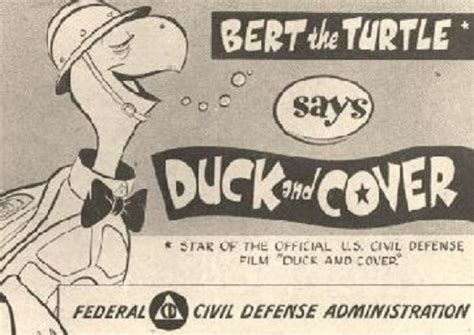
Bert also starred in a 1951 atomic film called Duck and Cover produced by the FDCA. Here is a link to that short film:
Another part of the plan to protect the American public was to utilize fallout shelters. These shelters, often in the basement of large public buildings, were designed to house and protect the public from the radiation dangers associated with an atomic blast. In the 1950s and into the 1960s, schools, colleges, and universities in the United States had some form of a fallout shelter – often in the lowest part of the building. Fallout shelters were often found on the lowest level of an underground parking garage. The shelters, designated as such by Civil Defense officials, were built strictly for survival – not comfort. The federal government did provide certain supplies, which mainly consisted of large barrels of water, crackers, and limited supplies for sanitation. These were short-term shelters designed to offer protection for 48 to 72 hours. Beginning in 1958, the FCDA (by that time it was known as just Civil Defense) began to advocate for family shelters built in backyards. They even published guidelines so homeowners would know how to build, and stock their new shelter.
By the late 1960s, the idea that an atomic war was right around the corner had substantially subsided. Public fallout shelters were abandoned, often with their supplies left behind. The desire for home fallout shelters likewise subsided. Many of those shelters were converted to storage areas, play rooms, wine Caves, or simply filled in.
For roughly the last 45 the United States has enjoyed a time free from the worry of an atomic/nuclear war.
Until now…
(This is part one of a two-part article).


 thereluctantpreppers
Hello. I am from a blog focused on factual content and news commentary. We are currently doing a series on nuclear weapons. I was wondering if you would like to guest post over here?
Denis, I would like that very much!
I have sent you an invite to be a contributor on my site. Let me know if you need any help!